

Every player at a session gets a rating from 0 to 1 for how much they were engaged with the game. A 1 is the player who’s in every scene, talking fast, asking what the goblin said. A 0 is a player who is basically not participating in any meaningful way. Average those ratings across the whole table and the shape of the night makes almost no difference. Tables that never fight and tables that spend 40% of the night fighting both land between 0.77 and 0.79.
That flat average has two very different players inside it. Sort players by what they get into most (a combat fan is a player whose rating runs clearly higher during fights, a roleplay fan is the reverse) and split the nights into last week’s five shapes. The roleplay fans rate 0.83 or 0.84 in every one of the five. Simmer or Cold Open, they show up the same. The combat fans go from 0.60 on a Simmer to 0.74 on a Cold Open.
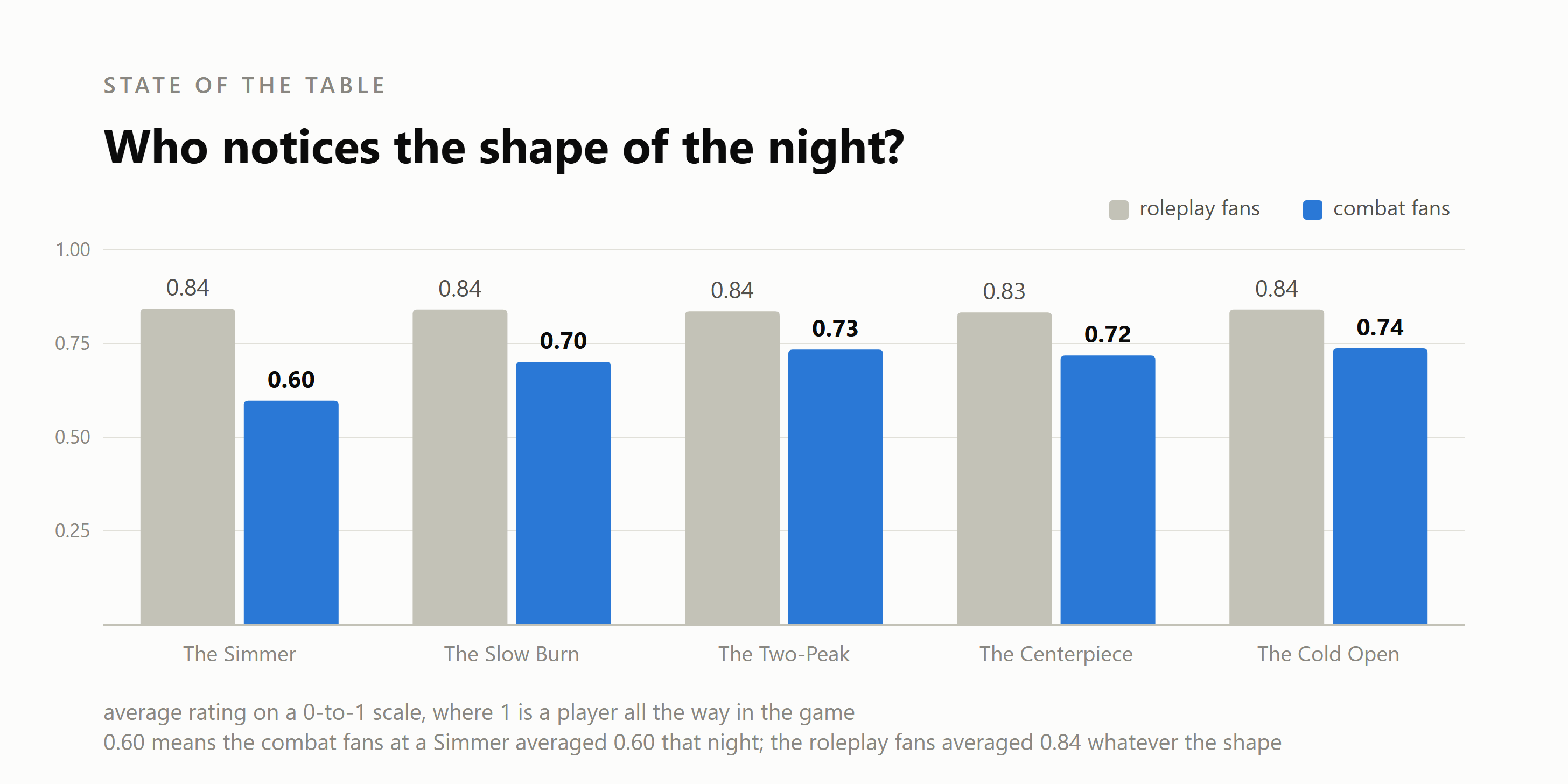
The roleplay fans are the half of this worth underlining. Part of the combat-fan swing is built in (sort a player by their combat rating and of course they rate higher on the fightier nights). Nothing about the roleplay side is built in. If any player was going to drift on a night that opens with an ambush and stays in initiative for an hour, you’d guess it was the one who came for the talking… but they don’t. The Cold Open has the least talk of the five shapes, and the roleplay fans give it the same 0.84 they give a night with no fight in it. Whatever the night turns out to be, they’re in it.
Every table has a least engaged seat, by definition. What’s striking is how little the night changes that seat’s rating: about 0.60 in a Simmer, about 0.60 in a Cold Open. The Cold Open lifts the combat fans. It doesn’t lift the seat at the bottom, and neither does any other shape.
So does anything move the least engaged seat?
Not how much the DM talks. Players at a table where the DM does under 30% of the talking rate about the same as players at a table where the DM does over 70%. What moves it is how many players are at the table. At a table of two, four seats in ten are rated 0.9 or higher, all the way in. At a table of seven or more, one in five. The typical seat drifts from 0.79 to 0.75 along the way. And the bottom barely moves: the share of seats rated under 0.5 stays near 4% from two players through six, and edges up to 7% at seven or more.
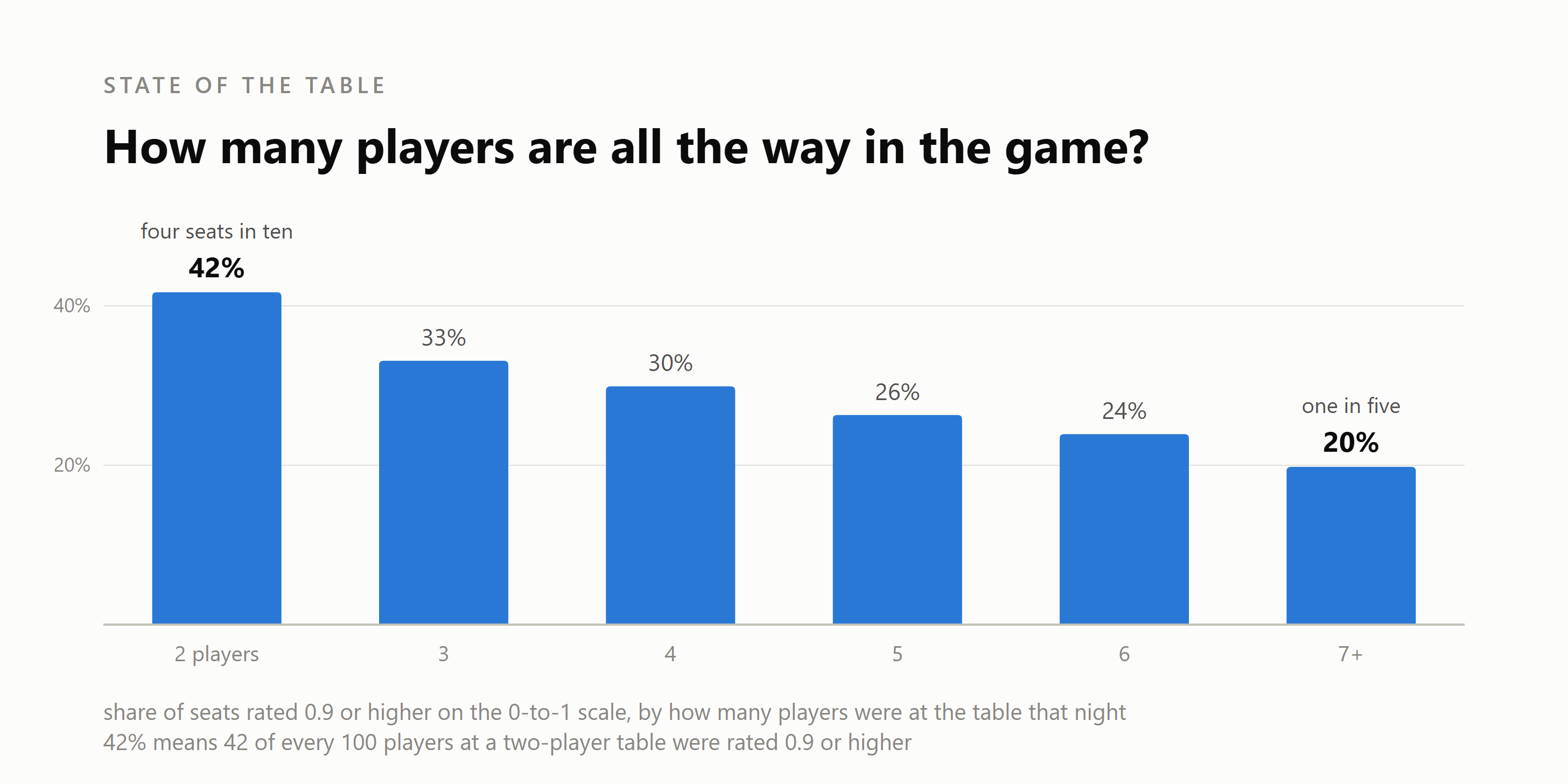
Bigger tables also tend to play longer, and longer nights rate a little higher, so the length of the night is certainly pushing the other way. One caveat though - at a table of seven, each player gets a smaller slice of the night, and a player we hear less from is also a player there’s less to go on for. “Rated a little lower” and “harder to read” can’t be pulled apart from here.
So a bigger table shaves a little off everyone’s rating without adding to the seats near the bottom. The least engaged seat sits near 0.60 whatever shape the night takes.