

We looked for the adventure behind every campaign in our data set. In one campaign in three we could name a published book. In the other two we could not, some combination of a pure homebrew world and books that we couldn’t recognize. For sake of simplicity, we’re going to call these latter two cases homebrew.
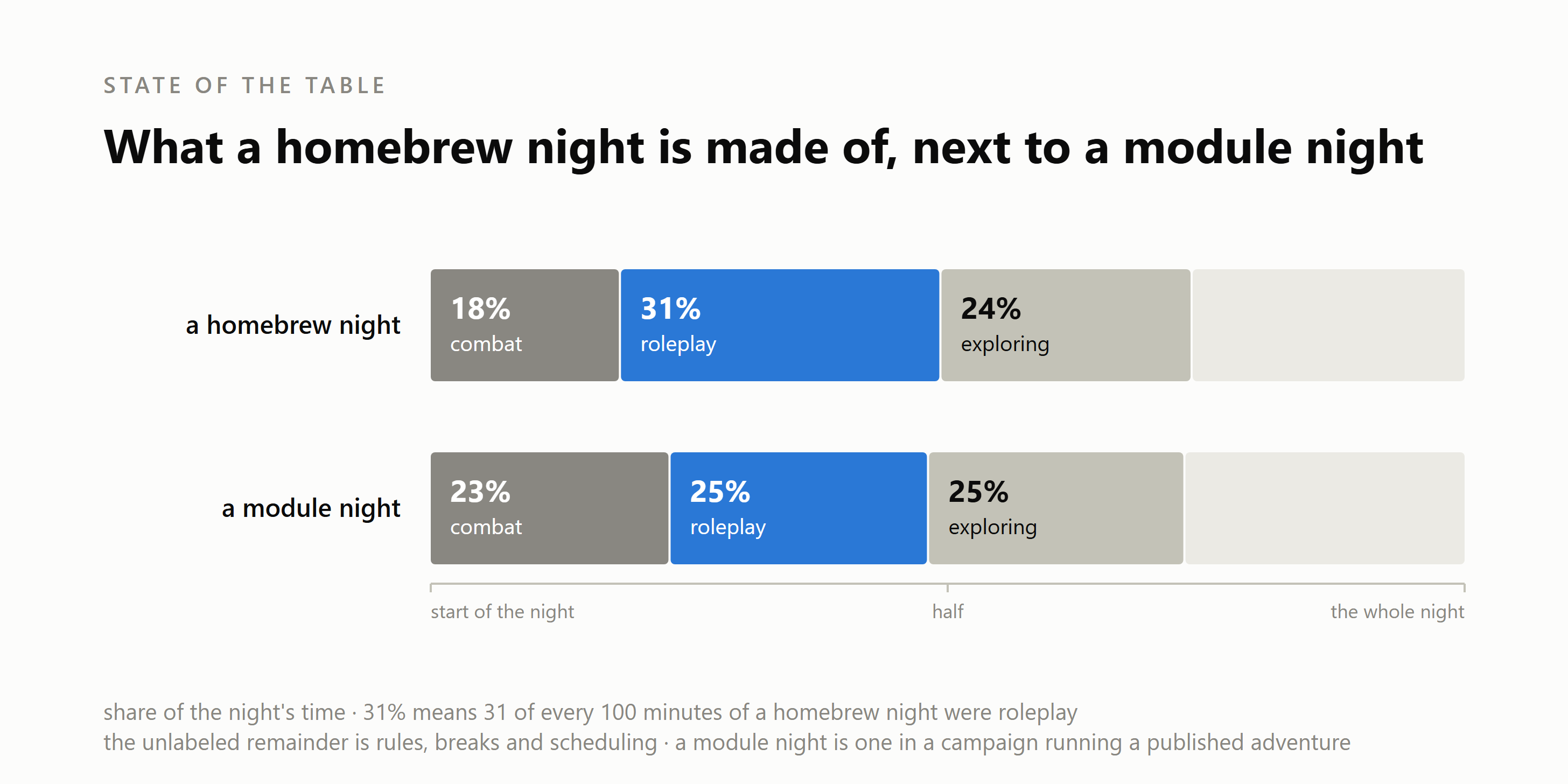
What those tables do with the night is different. Pick a random minute from a homebrew session and there is a 31% chance the table is in a roleplay scene and an 18% chance it is in a fight. Pick one from a session running a published adventure and it is 25% and 23%. Put the other way round, a homebrew night has no fight in it at all one time in three. A module night, one in five.
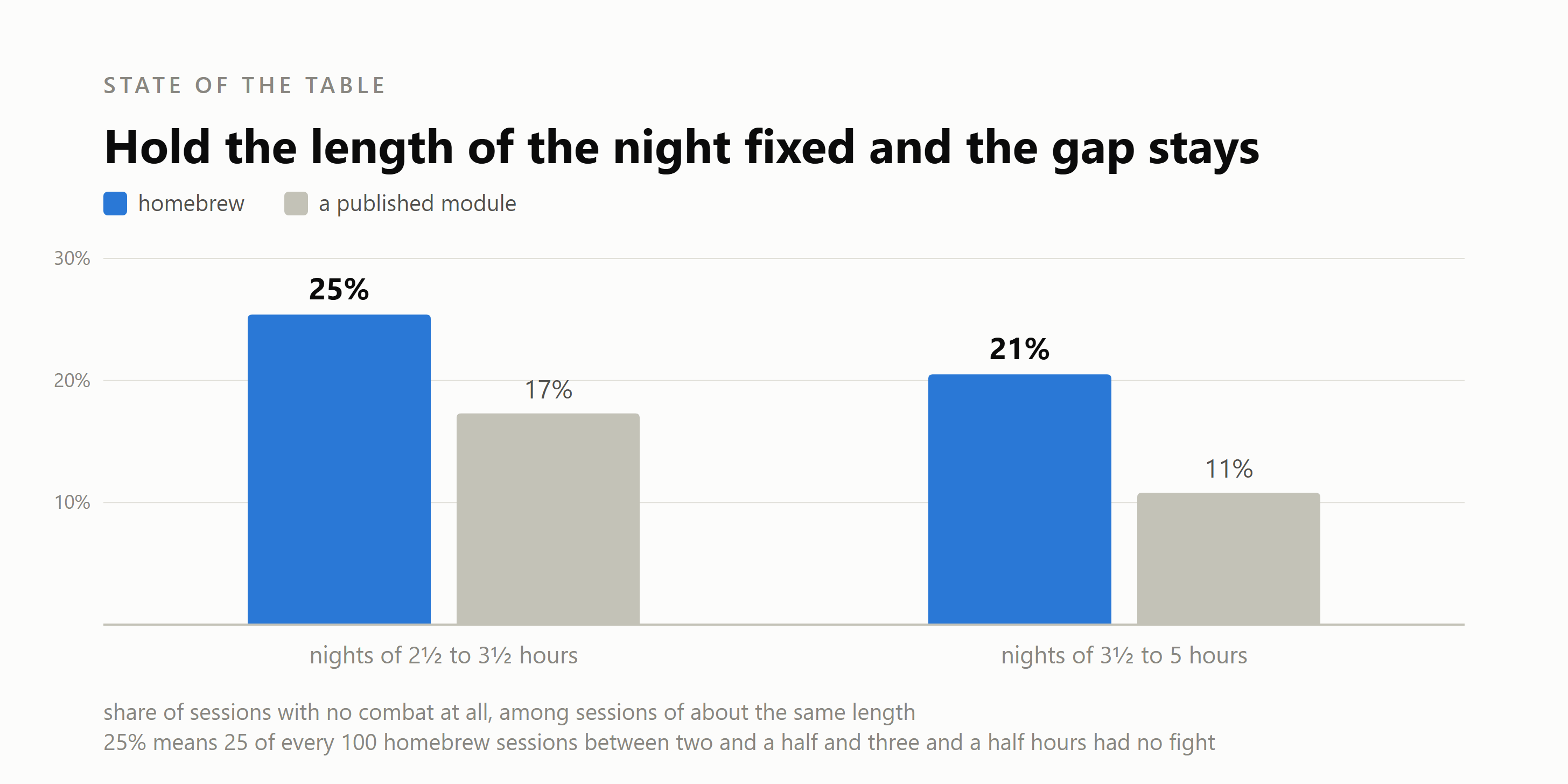
The first objection here is the clock, since (as established previously) short nights skip the fight. So hold the length fixed.. among sessions of two and a half to three and a half hours, the homebrew table has no fight 25% of the time and the module table 17%. Among sessions of three and a half to five hours, 21% against 11%. The roleplay gap is at least four points in every length band, it holds at every table size, and it holds in all D&D editions, so it isn’t the clock, the headcount, or the rulebook.
We had two guesses about why and the data seemed to reject both. The first was that fights are the expensive thing to invent.. a conversation can be made up at the table, a fight needs stat blocks and a map. If that’s true, one would expect the homebrew table to fall further behind as the night goes on and the prepared material runs out. It does the opposite. Twenty minutes into a module night the odds of being in combat are already 22% and on a homebrew night, 15%. That is the widest the gap gets, and by the second hour it has halved. So the book doesn’t seem to be supplying fights the DM didn’t build.
The second guess was that it is the table, not the book.. that people who write their own adventures are people who came to talk. However there are a large number of groups in the data set that have played both homebrew and published modules. On their own homebrew nights they run more roleplay and less fighting than on their published nights. So hand the same DM a book and the night moves toward the fight. What is left is I suppose smaller than either guess - a published adventure brings the fight forward and it does that to whoever is running it.
All of that to say, published modules certainly have their own quirks. A Curse of Strahd night is 31% roleplay and has no fight at all 29% of the time (quite close to homebrew numbers). Lost Mine of Phandelver runs the opposite way.. a fifth of the night is roleplay and the table fights on five nights in six.