

The Bard is the party’s mouth. That is the stereotype and, apparently, the reality.
Here is the yardstick. Take the players’ talk for the night, leaving the DM out, and split it evenly. In other words, at a table of four players, an even share is a quarter. Then ask, class by class, how many characters get at least that full share. Half of all Bards do. About a third of Barbarians do. Every other class sits in between, and most of them sit close together: Warlocks, Monks, Wizards, Paladins and Clerics all land a little above four in ten, Rogues, Druids, Rangers and Fighters a little under. The one class above the Bard is the Artificer, which is also the rarest class at the table, so make of that what you will.
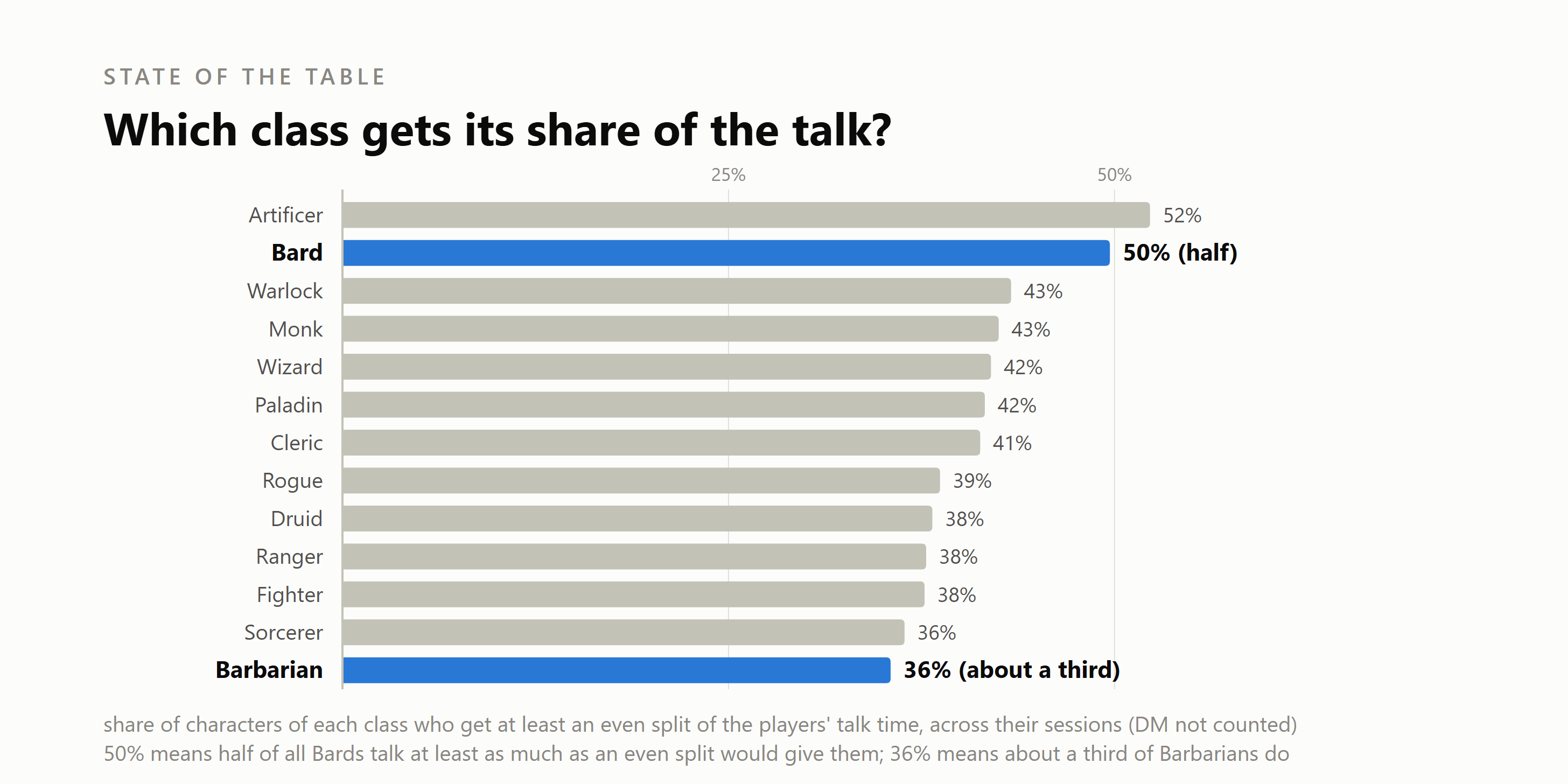
Put the two extremes at the same table and it holds. On nights where a Bard and a Barbarian were both present, the Bard did more of the talking 59% of the time. Against any tablemate of a different class, the Bard talks more 56% of the time and the Barbarian 45%.
There is, however, a wrinkle. Measure each character’s slice of the talk inside combat and compare it to their slice across the whole night. For six Barbarians in ten, the slice is bigger once the fight starts. Monks and Fighters are close behind, at nearly six in ten. For Wizards it is fewer than four in ten, and Bards sit with them at four. Run the same comparison inside roleplay scenes and it flips: half of Bards and Warlocks talk more there than they do overall, and fewer than a third of Barbarians and Fighters do.
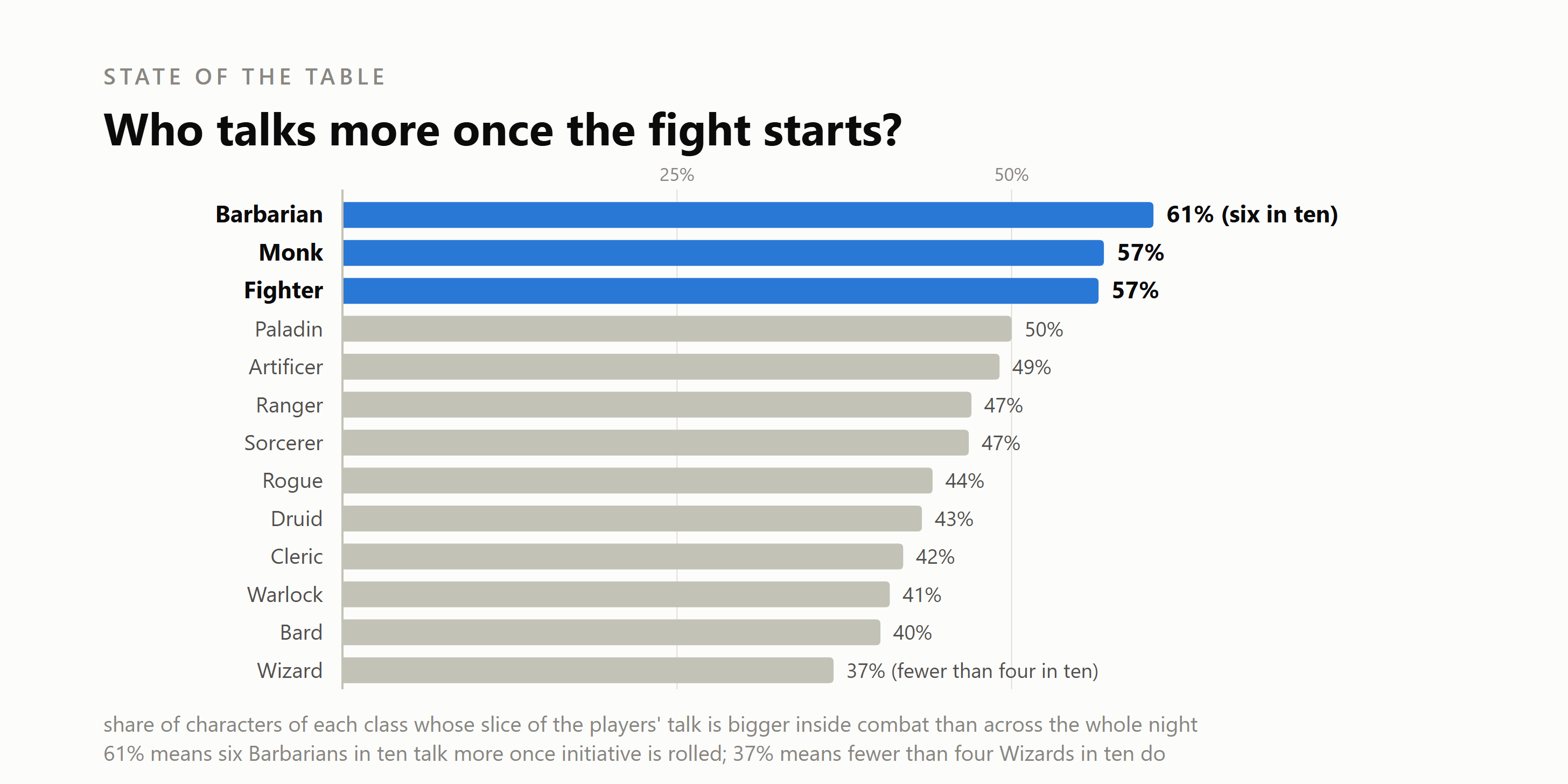
So the quiet classes aren’t quiet all night. They are quiet until something needs hitting.
One more number. The Fighter is the most common class at the table, one player character in ten, and it is third from the bottom of the talk list. The class most people pick is a class that, more often than not, lets someone else do the talking (at least until the fighting starts).